volleyball ball
Playing sports with friends brings pure joy and energy. However, picking the right gear makes a big difference in how much fun you have. If you pick a hard or heavy ball, your arms will hurt fast.
A great volleyball ball feels smooth, bounces well, and stays soft on your hands. Whether you play inside a gymnasium or out on warm beach sand, picking the correct ball helps you serve better and pass with total control.
In this clear guide, we will look at all the key choices available today. You will learn how indoor balls differ from outdoor models, what gear pro players trust, and how to pick a stylish design that fits your personal style.
Complete Volleyball Ball Specifications Matrix
| Feature / Detail | Indoor Volleyball | Beach Volleyball | Youth / Beginner |
| Official Circumference | 65 – 67 cm (25.5 – 26.5 in) | 66 – 68 cm (26.0 – 27.0 in) | 63 – 65 cm (25.0 – 25.5 in) |
| Official Weight | 260 – 280 g (9.2 – 9.9 oz) | 260 – 280 g (9.2 – 9.9 oz) | 220 – 240 g (7.8 – 8.5 oz) |
| Internal Air Pressure | 4.26 – 4.61 psi | 2.50 – 3.20 psi | 3.00 – 4.00 psi |
| Outer Material | Composite or Genuine Leather | Water-resistant Synthetic Leather | Soft Foam or Padded Synthetic |
| Panel Construction | Glued / Molded Panels | Stitched / Sewn Panels | Molded or Soft-Stitched |
Why Picking the Right Ball Matters
Every game feels better when you use proper gear built for your court. A heavy street ball can hurt your forearms when you try to bump it.
On the other hand, a soft volleyball ball lets you practice passing for hours without red marks on your skin. When the pressure and weight match your skill level, your sets stay accurate and your serves land right where you aim.
Understanding the Indoor Volleyball Ball
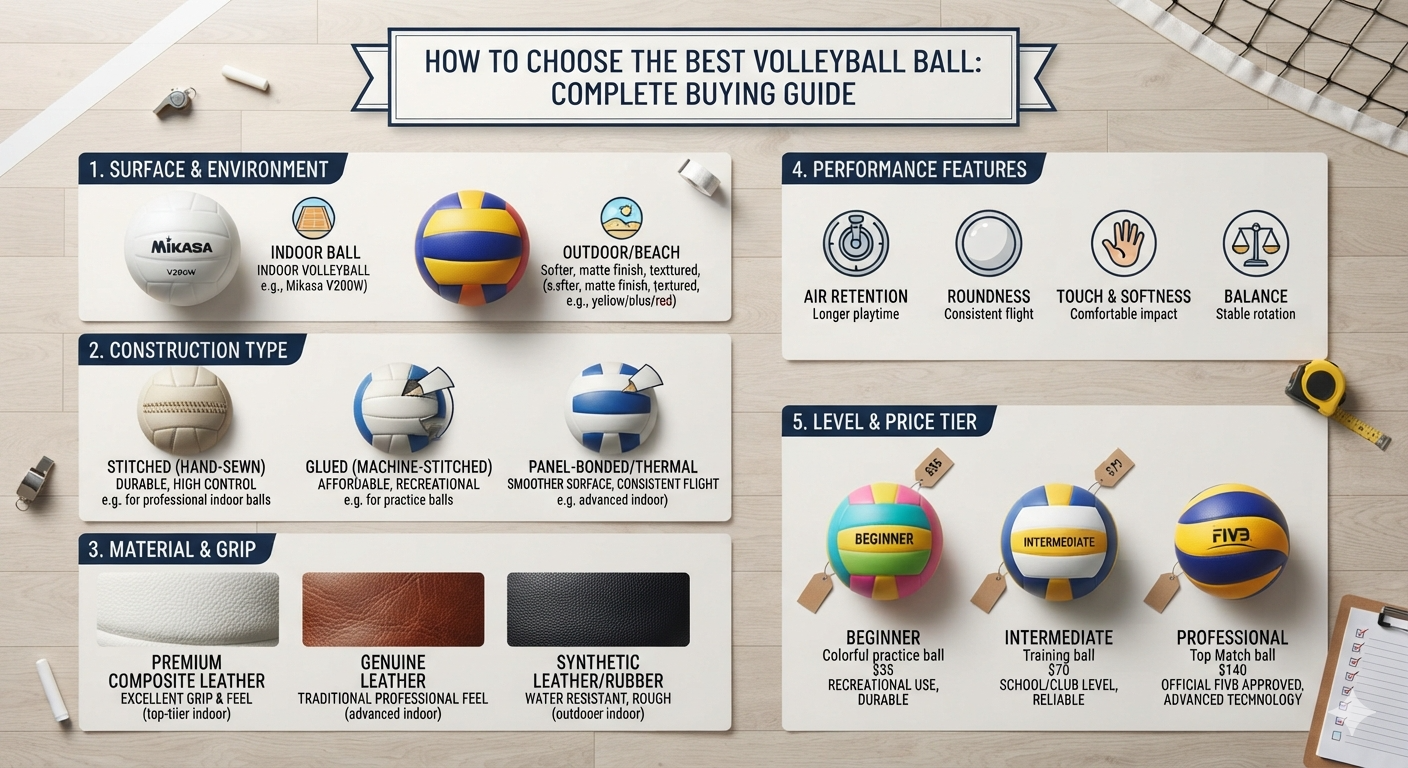
Indoor games need speed, quick bounces, and precise control on smooth wooden floors. An indoor volleyball ball uses tightly glued leather panels over a rubber bladder.
This smooth surface helps it fly fast through the gym air. Because indoor courts stay dry, these balls do not need heavy water protection, allowing manufacturers to focus purely on touch and true flight.
Exploring the Outdoor Beach Volleyball Ball
Playing outside on sand requires a totally different design strategy. A beach volleyball ball is slightly larger and pumped to a lower air pressure than an indoor version.
The outer panels are stitched together tightly so wet sand and lake water cannot soak inside. This water-resistant outer coat keeps the weight light and prevents the cover from getting heavy or waterlogged during outdoor summer play.
What Makes a Professional Volleyball Ball Different?
When you watch high-level tournaments, you see gear made with extreme precision. A professional volleyball ball features dimpled micro-fiber covers that cut down air turbulence during hard spikes.
These panels give top athletes extra grip when setting. League inspectors test every single game ball for exact weight, bounce height, and circumference before any match begins.
How to Find the Best Volleyball Ball for Your Budget
Buying gear does not mean you have to spend a fortune. To find the best volleyball ball for your personal needs, think about where you play most often.
Beginners should look for composite leather options with soft-touch backing. Premium models cost a bit more, but they last for years of regular practice while keeping their shape and air pressure steady.
Fun Styles: The Popular Volleyball Ball Pink Choice
Sports equipment should reflect your unique personality on the court. A volleyball ball pink design stands out immediately during open gym sessions or casual park games.
Bright neon colors are not just about style; they also make the rotating sphere much easier to track against dark gym walls or bright sunny skies when calling for a set.
Finding High Quality Ball Volleyball Ball Images
If you run a team website or love sports photography, crisp photos are essential. Clear ball volleyball ball images showcase key surface features like panel stitching, valve placement, and valve seams.
Studying detailed pictures lets players inspect panel alignment and cover texture before making an online purchase. High-resolution shots also show how light reflects off composite materials compared to matte outdoor synthetic surfaces.
Creative Inspiration: The Volleyball Ball Drawing
Learning to create a volleyball ball drawing is a great exercise for young artists and sports fans alike. The classic design uses eighteen curved panels arranged in six distinct sections.
Drawing these sweeping curves helps you understand the spherical geometry of modern gear. You can start with a simple circle, sketch the overlapping arc lines, and finish with bold colors or realistic shading.
Essential Care Tips to Extend Product Life
Taking proper care of your gear ensures it stays soft and bouncy for seasons to come. Always store your equipment inside at room temperature, away from hot car trunks or damp basements.
Use a dedicated inflation needle wiped with a drop of silicone oil before pumping air into the valve. Wiping down the outer cover with a damp cloth after outdoor sand sessions removes abrasive grit that can wear down outer seams.
Conclusion
Choosing the right equipment elevates your entire playing experience. From soft-touch beginner options to championship-grade gear, matching your ball to your environment makes every serve, set, and spike feel effortless. Grab your favorite model, gather your friends, and enjoy your next game on the court!
Frequently Asked Questions
1. What is the standard size for an adult volleyball ball?
An official adult size 5 model measures 65 to 67 centimeters in circumference and weighs between 260 and 280 grams.
2. Can I use an indoor ball on the beach?
It is not recommended. Indoor covers absorb water and collect wet sand, which ruins the glue and makes the ball heavy.
3. How much air pressure should I put in my ball?
Indoor game balls require 4.26 to 4.61 psi, while outdoor beach models perform best at a lower pressure of 2.50 to 3.20 psi.
4. What is the difference between glued and stitched panels?
Glued panels create a smooth, fast surface ideal for indoor floors, whereas stitched panels hold up better against sand, dirt, and moisture outdoors.
5. Why are colorful options like pink or yellow so popular?
Bright patterns help players track the rotation and speed of the sphere quickly against complex backgrounds like bright sunlight or gym lighting.
6. How do I clean my gear after playing outdoors?
Wipe the surface with a soft, damp cloth and mild soap. Air-dry it away from direct sunlight, and never submerge the inflation valve in water.
About the Author